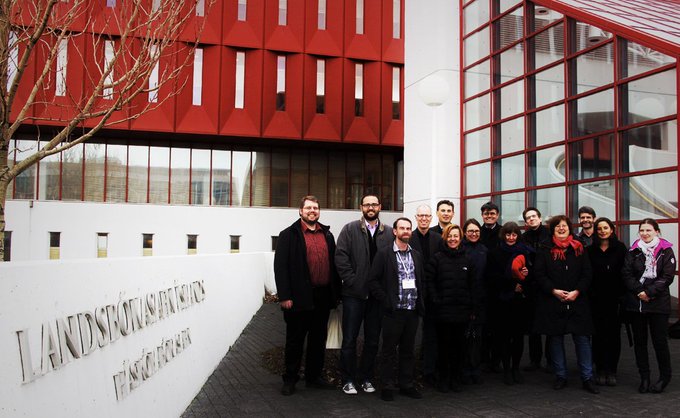
April 28, 2016

New 'semi-stable' build for Heritrix

Earlier this month I mentioned that I was planning on making another one of my "semi-stable" Heritrix build, using the current master 3.3.0. This work is now underway in the Landsbokasafn Heritrix repo on GitHub. LBS-2016-02.

Heritrix 3.3.0-LBS-2016-02
I've merged in one pull request that is still open in the IA repository, #154 Fixes for apparent build errors. Most notably, this makes it possible to have Travis-CI build and test Heritrix.

You can review the full list of changes between my last Heritrix build (2015-01) and this new one here. Here is a list of the main changes:

  • Some fixes to how server-not-modified revisit records are written (PR #118).
  • Fix outlink hoppath in metadata records (PR #119)
  • Allow dots in filenames for known good extensions (PR #120)
  • Require Maven 3.3 (PR #126
  • Allow realm to be set by server for basic auth (PR #124)
  • Better error handling in StatisticsTracker (PR #130)
  • Fix to Java 8 Keytool (PR #129) - I wrote a post about this back in 2014.
  • Changes to how cookies are stored in Bdb (PR #133)
  • Handle multiple clauses for same user agent in robots.txt (PR #139)
  • SourceSeedDecideRule and SeedLimitsEnforcer (PR #137 and #148)
  • 'Novel' URL and byte quotes (PR #138)
  • Only submit 'checked' checkbox and radio buttons when submitting forms (PR #122)
  • Form login improvements (PR #142 and #143)
  • Improvements to hosts report (PR #123)
  • Handle SNI error better (PR #141)
  • Allow some whitespace in URLs extracted by ExtractorJS (PR #145)
  • Fix to ExtractorHTML dealing with HTML comments (PR #149)
  • Build against Java 7 (PR #152)

I've ignored all pull request that apply primarily to the contrib package in the above. There were quite a few there, mostly (but not exclusively) relating to AMQP.

I've done some preliminary testing and everything looks good.  So far, the only issue I've noted is one that I was already aware of, about noisy alerts relating to 401s.

I'll be testing this version further over the next few weeks and welcome any additional input.

April 18, 2016

A long week is over. Thank you all.

The 2016 IIPC General Assembly and Web Archiving Conference is over. Phew!

Me, opening the Harvesting Tools
session on Tuesday

I always look forward to this event each year. It is by far the most stimulating and productive meeting/conference that I attend regularly. I believe we managed to live up to that this time.

The meeting had a wonderful Twitter back-channel that you can still review using the hashtags #iipcGA16 and #iipcWAC16.

It has been over two years since we, at the National and University Library of Iceland, offered to host the 2016 GA, and over a half year before that when the initial decision was made. Even with a 2.5 year lead time, it barely felt like enough.

I'd like to take this opportunity to thank, again, all the people who helped make last week's event a success.

First off, there is the program committee, which was very small this year, comprising, in addition to myself, (in alphabetical order) Alex Thurman (Columbia University Libraries), Gina Jones (Library of Congress), Jason Webber (IIPC PCO/British Library), Nicholas Taylor (Stanford University Libraries) and Peter Stirling (Bibliothèque nationale de France). I literally couldn't have done this without you.

I'd also like to note the contribution of our incoming PCO in this list, Olga Holownia who put in a lot of work during the conference to help make sure everything was just right for each session.

Next, I'd like to thank my colleagues at the National Library who assisted me in organizing this event and helped out during by week by handling registration, running tours etc. It was a team effort. Notable mentions to Áki Karlsson and Erla Bjarnadóttir who spent much of the week making sure that all the little details were attended to.

The Steering Committee on Friday
following the SC meeting
A big thank you to all the speakers and session moderators.

And lastly, I'd like to thank the members of the Steering Committee for being willing to entrust the single most important event of the IIPC calendar to one of the IIPC's smallest members. Indeed, doing so without the slightest hesitation.

I've learned a lot from this past week and I hope to be able to distill that experience and write it up so that next year's GA/WAC can be even better. But that will have to wait for another day and another blog post.

For now, I'll just say thanks for coming and see you all again in Lisbon for #iipcGA17 and #iipWAC17.

April 7, 2016

Still Looking For Stability In Heritrix Releases

I'd just like to briefly follow up on a blog post I wrote last September, Looking For Stability In Heritrix Releases.

The short version is that the response I got was, in my opinion, insufficient to proceed. I'm open to revisiting the idea if that changes, but for now it is on ice.

There is little doubt in my mind that having (somewhat) regular stable releases made of Heritrix would be of notable benefit. Even better if they are published to Maven Central.

Instead, I'll continue to make my own forks from time to time and make sure they are stable for me. The last one was dubbed LBS-2015-01. It is now over a year old and a lot has changed. I expect I'll be making a new one in May/June. You can see what's changed in Heritrix in the meantime here.

I know a few organizations are also using my semi-stable releases. If you are one of them and would like to get some changes in before the next version (to be dubbed LBS-2016-02), you should try to get a PR into Heritrix before the end of April. Likewise, if you know of a serious/blocking bug in the current master of Heritrix, please bring it to my attention.

April 1, 2016

Duplicate DeDuplicators?


A question on the Heritrix mailing list prompted my to write a few words about deduplication in Heritrix and why there are multiple ways of doing.

Heritrix's built in service


Heritrix's inbuilt deduplication service comes in two processors. One processor records each URL in a BDB datastore or index (PersistStoreProcessor), the other looks up the current URL in this datastore and, if it finds it, compares the content digest (FetchHistoryProcessor).

The index used to be mingled in with other crawler state. That is often undesirable as you may not wish to carry forward any of that state to subsequent crawls. Typically, thus, you configure the above processors to use their own directory by wiring in a special "BDB module" configured to write to an alternative directory.

There is no way to construct the index outside of a crawl. Which can be problematic since a hard crash will often corrupt the DBD data. Of course, you can recover from a checkpoint, if you have one.

More recently, a new set of processors have been added. The ContentDigestHistoryLoader and ContentDigestHistoryStorer. They work in much the same way except they use an index that is keyed on the content digest, rather than the URL. This enables URL agnostic deduplication.

This was a questionable feature when introduced, but after the changes made to implement a more robust way of recording non-URL duplicates, it became a useful feature. Although its utility will vary based on the nature of your crawl.

As this index is updated at crawl time, it also makes it possible to deduplicate on material discovered during the same crawl. A very useful feature that I now use in most crawls.

You still can't build the index outside of a crawl.

For more information about the built in features, consult the Duplication Reduction Processors page on the Heritrix wiki.

The DeDuplicator add-on


The DeDuplicator add-on pre-dates the built in function in Heritrix by about a year (released in 2006). It essentially accomplishes the same thing, but with a few notable notable differences in tactics.

Most importantly, its index is always built outside of a crawl. Either from the crawl.log (possibly multiple log files) or from WARC files. This provides a considerable amount of flexibility as you can build an index covering multiple crawls. You can also gain the benefit of the deduplication as soon as you implement it. You don't have to run one crawl just to populate it.

The DeDuplicator uses Lucene to build its index. This allows for multiple searchable fields which in turn means that deduplication can do things like prefer exact URL matches but still do digest only matches when exact URL matches do not exist. This affords a choice of search strategies.

The DeDuplicator also some additional statistics, can write more detailed deduplication data to the crawl.log and comes with pre-configured job profiles.

The Heritrix 1 version of the DeDuplicator actually also supported deduplication based on 'server not modified'. But it was dropped when migrating the H3 as no one seemed to be using it. The index still contains enough information to easily bring it back.

Bottom line


Both approaches ultimately accomplish the same thing. Especially after the changes that were made a couple of years ago to how these modules interact with the rest of Heritrix, there really isn't any notable difference in the output. All these processors, after determining an document is a duplicate, set the same flags and cause the same information to be written to the WARC (if you are using ARCs, do not use any URL agnostic features!)

Ultimately, it is just a question of which fits better into your workflow.


March 18, 2016

Declaring WARR on "CDX Server" API

Work is currently ongoing to specify a "CDX Server API" for OpenWayback. The name of this API has, however, caused an unfortunate amount of confusion. Despite the name, the data served via this API needn't be in CDX files!

The core purpose of this API is to respond to a query containing an URL and optionally a timestamp or timerange with a set of records that fall within those parameters. This is meant to support two basic functionalities. One, replay of captured web content and, two, discovery of capture web content.

CDXs need not enter into it. It is just that the most common way (by far) to manage such an index is to use sorted CDX files. Thus the unfortunate name. Nothing prevents alternative indexing solutions being used. You could use a relational database, Lucene or whatever tool allows lookups of strings!

So, this API desperately needs a new name. My suggestion is "Web Archive Resource Resolution Service" or WARR Service for short. Yes, I did torture that until it produced a usable acronym.

In my last post I discussed changes to the CDX file format itself. Those changes should facilitate WARR servers running on CDX indexes. But ultimately, the development of the WARR Service API is not directly coupled to those changes. We should focus on developing the WARR Service API with respect to the established use cases.

In truth, the exact scope and nature of this new API remains debated. You can find some lively discussion in this Github issue. More on that topic another day.

March 17, 2016

Rewriting the CDX file format

CDX files are used to support URL+timestamp searching of web archives. They've been around for a long time, having first been used to catalog the contents of ARC files. Despite the advent of the WARC file format, they haven't changed much. I think it is past due that we reconsider the format from the ground up.

The current specification lists a large number of possible fields. Many are not used in typical scenarios.

The first field is a canonicalized URL. I.e. an URL with trivial elements (such as protocol) removed so that equivalent URLs end up with the same canonical URL here. This serves as the primary search key.

The only problem with this is that searching for content in all subdomains is not possible without scanning the entire CDX. This is because the subdomain comes before the domain. Instead, we should use a SURT (Sort-friendly URI Reordering Transform) form of the canonical URL instead. SURT URLs turn the domain/sub-domain structure around, making such queries fairly straightforward. There is essentially no downside to doing this and, in fact, a number of CDXs have been built in this manner, regardless of any "formal" standardization (as there isn't really any formal standard).

I suggest that any revised CDX format mandate the use of SURT URLs for the first field. Furthermore, we should utilize the correct SURT format. In most (probably all) current CDXs with SURT URLs, an annoying mistake has been made where the closing comma is missing. An URL that should read:
   com,example,www,)
instead reads:
   com,example,www)
The protocol prefix has been removed as unnecessary along with the opening ellipse. 

The second field should remain the timestamp with whatever precision is available in the ARC/WARC. I.e. an w3c-iso8601 of varying accuracy as per this proposed revision the WARC standard (the revision is extremely likely to be included in WARC 1.1).

The third field would remain the original URL.

The fourth field should be a content digest including the hashing algorithm. Presently, this field is missing the algorithm.

The fifth field would be the WARC record type (or a special value to indicate an ARC response record). This is the most significant change as it allows us to capture additional WARC record types (such as metadata and conversion) while also handling the existing fields in a more targeted manner (e.g. response vs revisit). It might be argued that this should be the second field to facilitate searches of a specific record type. I believe that, probably implemented, this field would allow replay tools to effectively surface any content "related" to the URL currently being viewed, a problem that I know many are trying to tackle.

The next two fields would be the WARC (or ARC) filename (this is supposed to be unique) of the file containing the record and offset at which the record exists within the (W)ARC. This is as it works currently. Some would argue for a more expressive resource locator here, but I believe that is best handled be a separate (W)ARC resolution service. Otherwise you may have to substantially rebuild your CDX index just because you moved your (W)ARCs to a new disk or service.

Lastly, there should be a single line JSON "blob" containing record type relevant additional data. For response records, this would include HTTP status code and content type which I've excluded from the "base" fields in the CDX. This part would be significantly more flexible due to the JSON format, allowing us to include optional data where appropriate etc. The full range of possible values is beyond the scope of this blog post.

There is clearly more work to be done on the JSON aspect, plus some adjustments may be necessary to the base data, but I believe that, at minimum, this is the right direction to head in. Of course, this means we have to rebuild all our CDX files in order to implement this. That's a tall order, but the benefits should be more than enough to justify that one-time cost.

February 24, 2016

3 things I shouldn't have to tell you about running a "good" crawler

I've been running large and small scale crawls for almost 12 years. In that time I've encountered any number of unfortunate circumstances where our crawler has caused a website some amount of trouble. We always aim to run a "good" crawler. One that is respectful of website operators and doesn't cause any issues. To accomplish this we have some basic rules and limits to abide by. The reasons we sometimes do cause trouble comes down to the complicated nature of the internet.

During this time I've also been responsible for operating a number of websites. Including a few that are (by Icelandic standards) quite popular. Doing so has shown me the other side of web crawling. Turns out that a lot of crawlers are not following the basics dos and don'ts of web crawling. Including some supposedly respectable crawlers.

This seems to be getting worse each year.

Of course there are "bad" robots. Run by people who do not care about the negative impact they cause. But, even "good" robots (i.e. ones that at least seem to have good intentions) are all to frequently misbehaving.

So, here are 3 things you absolutely should abide by if you want your robot to be considered "good". Remember, it doesn't matter if your robot is a web-scale crawl or a scraping of a single site. As soon you've scripted something to automatically fetch stuff from a 3rd party server (without the 3rd party's explicit permission) you are running a crawler.

1. Be polite

Never do concurrent requests to the same site. Rate limit yourself to around 1 request every 2-5 seconds or so. More if the responses are slow. If you hit a 500 error code, wait a few minutes.

If you know (with certainty) that the site you are crawling can handle a more aggressive load (e.g. crawling google.com), it may be OK to step it up a bit. But when crawling sites where you do not have any insight, it is best to be cautious. Remember, yours is probably not the only crawler hitting them. Not to mention all the regular users.

I know, it can be infuriating when trying to scrape a large dataset. It could take weeks! But your needs do not outweigh the needs of other users. Also, crawlers are often more expensive to serve than "normal" users. They tend to systematically go through the entire site, meaning that caching strategies fail to speed up their requests.

2. Identify yourself

Your user agent string must contain enough information to allow a website operator to find out who you are, why you are crawling their site and how to get in touch with you. This isn't negotiable.

It also goes for little custom tools built to just scrape that one website. You don't have to set a user agent if you are using e.g. curl on the command line to get a single resource. But the moment you script or program something you must put identifying information in the user agent string. If all I see is

  curl/7.19.7 (x86_64-redhat-linux-gnu) lib...

I'll assume it is a "bad" crawler. Same for things written in Python, Java etc. Always identify yourself.

And make sure you are responsive to feedback you may get. Something, a number of big, supposedly "good" crawl operators fail to do.

The thing is, if your robot is causing a problem and I don't know who is operating it. I will ban it. Should you wish to have that ban lifted, I will not be especially predisposed towards cooperation. You've already made a very bad first impression.

Yes, you might be able to get around a ban by getting a new IP address, but at that point you are no longer running a "good" crawler.

The bottom line is, even if you are very careful, your crawler may inadvertently cause a problem. In those scenarios. If your intentions are good, then you must make yourself available to deal with the issue and prevent it from reoccurring. If you do not do this, you are running a "bad" crawler.

3. Honor robots.txt

I'm aware of the irony here. As an operator of a legal deposit crawler, I do not respect robots.txt in most of the crawls I conduct. But you probably don't have that shield of being legally required to "get all the URLs".

A lot of websites block perfectly "legitimate" material using robots.txt (e.g. images). It is annoying. But if you are running a "good" crawler, then you have to abide by these rules, including the crawl delay. You really should also be able to parse the newer wildcard rules.

At most, you might bend the rules to get embedded content (images) necessary to render the page. Even that should be done carefully and only while adhering to the first two rules firmly.

If you feel you need content blocked by robots.txt, you must ask for it. Politely. Some sites may be happy to assist you (ours included). Others may tell you to go away. Either way, if you are running a "good" crawler, you'll have your answer.