Having screenshots of web pages can be a useful augmentation to a web archive by providing a record of how the website looked in browsers contemporary to the capture. With browser based crawling becoming more common, creating these is, likewise, becoming easier.
Currently, any screenshots stored in WARCs are invisible in replay tools, significantly reducing their usefulness and it is not entirely clear how these screenshots should be stored in WARCs. It is important that a standard way be defined for this type of 'associated resource' so that replay tools can consistently provide consistent access to them.
I've used the term 'associated resource' rather than just 'screenshot' as there are other types of 'data associated' with an URL that we may wish to store. An obvious example might be a video that is embedded in a webpage in a manner that can not be easily crawled or replayed. That video might be extracted through side channels and associated with the original web page via the same mechanism. Replay tools would then, at minimum, provide links to open the video in their 'header'. More advanced replay tools might use advanced rewriting rules to inject it into, e.g. YouTube pages.
There are likely a number of other uses for this type of mechanism. Another example might be to attach some type of annotation/documentation that is attached in this manner to a URL, either via manual curation or an automatic process.
As these are not 'just' metadata that is available for 'big data' style processing, it is important to carefully consider this from the perspective of the replay tools. Notably, how we store this in WARC must facilitate easy discovery using typical web archive indexing (CDX/URL based indexing).
We must also consider that each 'associated resource' will require some amount of metadata to provide suitable context for the replay tool. This goes beyond just type (screenshot, video), but also, e.g. type of capture (is the screenshot based on the same HTTP transaction as the primary resource, was is created in parallel, or was it perhaps created via a replay mechanism), which browser was used etc.
An initial idea might be to store each of these 'associated resources' in a WARC resource record using the URL of the primary resource with a special prefix. E.g. PREFIX:http://example.org. Metadata could then be stored in the record's header using a set of custom fields, a single 'metadata' field containing a JSON 'payload' or some mix of the two.
I'm unsure if this is the best approach, but it serves as a starting point. Over the next few months I'm hoping, with broad input from the people who are building the tools that create and use this data, to write up a proposal for standardizing this that the IIPC could endorse. The document might also include some 'best practice' guidance to how replay tools should handle this data.
If you would like to be a part of that conversation, please get in touch.
Showing posts with label iipc. Show all posts
Showing posts with label iipc. Show all posts
November 12, 2018

October 10, 2016
Wanted: New Leaders for OpenWayback
[This post originally appeared on the IIPC blog on 03/10/2016]
The IIPC is looking for one or two people to take on a leadership role in the OpenWayback project.
The OpenWayback project is responsible not only for the widely used OpenWayback software, but also for the underlying webarchive-commons library. In addition the OpenWayback project has been working to define access related APIs.
The OpenWayback project thus plays an important role in the IIPCs efforts to foster the development and use of common tools and standards for web archives.

The OpenWayback project is at a cross roads. The IIPC first took on this project three years ago with
Originally this work was done by volunteers in our community. About two years ago the IIPC decided to fund a developer to work on it. The initial funding was for 16 months. With this we were able to complete the task of stabilizing the software as evidenced by the release of OpenWayback 2.0.0 through 2.3.0.
We then embarked on a somewhat more ambitious task to improve the core of the software. A significant milestone that is now ending as a new ‘CDX server’ or resource resolver is being introduced. You can read more about that here.
This marks the end of the paid position (at least for time being). The original 16 months wound up being spread over somewhat longer time frame, but they are now exhausted. Currently, the National Library of Norway (who hosted the paid developer) is contributing, for free, the work to finalize the new resource resolver.
I’ve been guiding the project over the last year since the previous project leader moved on. While I was happy to assume this role to ensure that our funded developer had a functioning community, I felt like I was never able to give the project the kind of attention that is needed to grow it. Now it seems to be a good time for a change.
With the end of the paid position we are now at a point where there either needs to be a significant transformation of the project or it will likely die away, bit by bit, which is a shame bearing in mind the significance of the project to the community and the time already invested in it.
the initial objective to make the software easier to install, run and manage. This included cleaning up the code and improving documentation.
While a technical background is certainly useful it is not a primary requirement for this role. As you may have surmised from the above, building up this community will definitely be a part of the job. Being a good communicator, manager and organizer may be far more important at this stage.
Ideally, I’d like to see two leads with complementary skill sets, technical and communications/management. Ultimately, the most important requirement is a willingness and ability to take on this challenge.
You’ll not be alone, aside from your prospective co-lead, there is an existing community to build on. Notably when it comes to the technical aspects of the project. You can get a feel for the community on the OpenWayback Google Group and the IIPC GitHub page.
It would be simplest if the new leads were drawn from IIPC member institutions. We may, however, be willing to consider a non-member, especially as a co-lead, if they are uniquely suited for the position.
If you would like to take up this challenge and help move this project forward, please get in touch. My email is kristinn (at) landsbokasafn (dot) is.
There is no deadline, as such, but ideally I’d like the new leads to be in place prior to our next General Assembly in Lisbon next March.
The IIPC is looking for one or two people to take on a leadership role in the OpenWayback project.
The OpenWayback project is responsible not only for the widely used OpenWayback software, but also for the underlying webarchive-commons library. In addition the OpenWayback project has been working to define access related APIs.
The OpenWayback project thus plays an important role in the IIPCs efforts to foster the development and use of common tools and standards for web archives.
Why now?

The OpenWayback project is at a cross roads. The IIPC first took on this project three years ago with
Originally this work was done by volunteers in our community. About two years ago the IIPC decided to fund a developer to work on it. The initial funding was for 16 months. With this we were able to complete the task of stabilizing the software as evidenced by the release of OpenWayback 2.0.0 through 2.3.0.
We then embarked on a somewhat more ambitious task to improve the core of the software. A significant milestone that is now ending as a new ‘CDX server’ or resource resolver is being introduced. You can read more about that here.
This marks the end of the paid position (at least for time being). The original 16 months wound up being spread over somewhat longer time frame, but they are now exhausted. Currently, the National Library of Norway (who hosted the paid developer) is contributing, for free, the work to finalize the new resource resolver.
I’ve been guiding the project over the last year since the previous project leader moved on. While I was happy to assume this role to ensure that our funded developer had a functioning community, I felt like I was never able to give the project the kind of attention that is needed to grow it. Now it seems to be a good time for a change.
With the end of the paid position we are now at a point where there either needs to be a significant transformation of the project or it will likely die away, bit by bit, which is a shame bearing in mind the significance of the project to the community and the time already invested in it.
the initial objective to make the software easier to install, run and manage. This included cleaning up the code and improving documentation.
Who are we looking for?
While a technical background is certainly useful it is not a primary requirement for this role. As you may have surmised from the above, building up this community will definitely be a part of the job. Being a good communicator, manager and organizer may be far more important at this stage.
Ideally, I’d like to see two leads with complementary skill sets, technical and communications/management. Ultimately, the most important requirement is a willingness and ability to take on this challenge.
You’ll not be alone, aside from your prospective co-lead, there is an existing community to build on. Notably when it comes to the technical aspects of the project. You can get a feel for the community on the OpenWayback Google Group and the IIPC GitHub page.
It would be simplest if the new leads were drawn from IIPC member institutions. We may, however, be willing to consider a non-member, especially as a co-lead, if they are uniquely suited for the position.
If you would like to take up this challenge and help move this project forward, please get in touch. My email is kristinn (at) landsbokasafn (dot) is.
There is no deadline, as such, but ideally I’d like the new leads to be in place prior to our next General Assembly in Lisbon next March.
May 12, 2016
What I learned hosting the 2016 IIPC GA/WAC
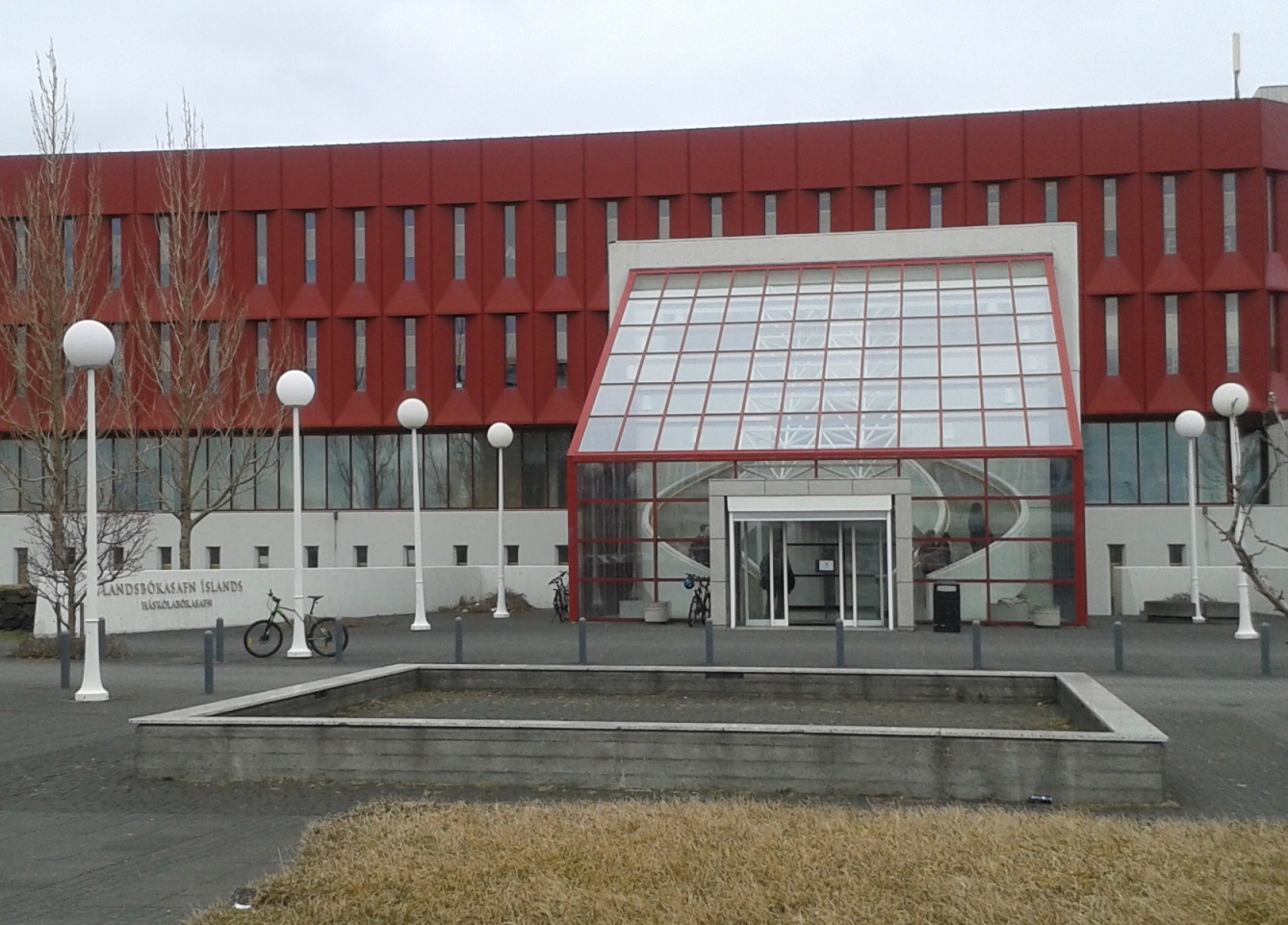 |
| National Library of Iceland Photo taken by GA/WAC attendee |
Plan ahead
Looking back, planning of the the practical aspects - logistics - of the conference seem to have been mostly spot on. The 2015 event in Stanford had had a problem with no-shows, but this wasn't a big factor in Reykjavik. I suspect largely due to the small number of local attendees. Our expectations about the number of people who would come ended up being more or less correct (about 90 for the GA and 145 for the WAC).
A big part of why the logistics side ran smoothly was, I feel, due to advance planning. We first decided to offer to host the 2016 GA in October of 2013. We made the space reservations at the conference hotel in September 2014. Consequently, there was never any rush or panic on the logistics. Everything felt like it was happening right on schedule with very few surprises.
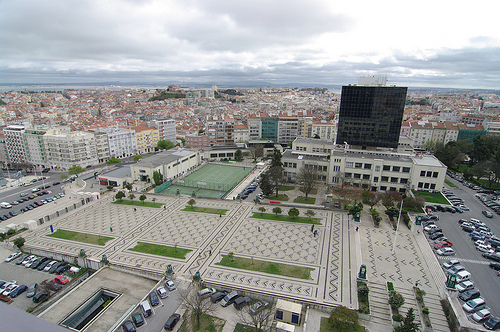 | |
| The IIPC SC had a meeting in Lisbon following the 2013 iPres conference. The idea for Reykjavik as the venue for the 2016 IIPC GA first arose there. |
Nothing, in my experience hosting a GA, has changed my mind about that.
Spendthrift
There was some discussion about whether some days/sessions should be recorded and put online. This was done in Stanford, but looking at the viewing numbers, I felt that it represented a poor use of money. Ultimately the SC agreed. Recording and editing can be quite costly. It may be worth reviewing this decision in the future. Or, perhaps something else can be used to 'open' the conference to those not physically present.
It was certainly a worthwhile experiment, but overall, I think we made the right decision not doing it in Reykjavik. Especially as the cost was quite, even compared to Stanford.
Another thing we decided not to spend money on was an event planner. I know one was used for the 2015 GA. That one needed to be planned in a hurry and thus may have required such a service. But I can't see how it would have made things much easier in 2016 unless you're willing to hand over the responsibility for making specific choices to the planner. Such as catering etc.
True, that does take a bit of effort, but I felt that was a part of the responsibility that comes with hosting. Just handing it over to a planner wouldn't have sat right. And if I'm vetting the planners choices, then very little effort is being saved.
I'm happy to concede, though, that this may vary very much by location and host.
Communication
Some of the communication surrounding the GA/WAC was sub-optimal. The GA page on netpreserve.org was never really up to the task, although it got better over time. Some of this was down to the lack of flexibility of the netpreserve website. Future events should have a solid communication plan at an early date. Including what gets communicated where and who is responsible for it. Perhaps it is time that each GA/WAC gets its own little website? Or perhaps not.
The dual nature of the event also caused some confusion. This led some people to only register for one of the two events etc. There was also confusion (even among the program committee!) about whether the CFP was for the WAC and GA or WAC only.
This leads us to the most important lesson I took away from this all...
Clearly separate the General Assembly and the Web Archiving Conference!
This isn't a new insight. We've been discussing what separates the 'open days' from 'member only' days for several years. In Reykjavik this was, for the first time, formally divided into two separate events. Yet, the distinction between them was less than absolutely clear.
This is, at least in part, due to how the schedule for the two events was organized. A single program committee was set up (as has been the case most years). It was quite small this year. This committee then organized the call for proposals (CFP) and arranged the schedule to accommodate the proposals that come in from the CFP.
This led to the conference over-spilling onto GA days (notably Tuesday). And it wasn't the first time that has happened. There was definitely a lack separation in Stanford (although perhaps for slightly different reasons) and in Paris, in 2014, the effort to shoehorn in all the proposals from the CFP had a profound effect on the member-only days.
This model of a program committee and a CFP is entirely suitable for a conference and should be continued. But going forward, I think it is absolutely necessary that the program committee for the WAC have no responsibility or direct influence on the GA agenda.
To facilitate this I suggest that the organization of these two events consist of three bodies (in addition to the IIPC Steering Committee (SC) which will continue to bear overall responsibility).
- Logistics Team. Membership includes 1-2 people from the hosting institution, the IIPC officers, at least one SC member (if the hosting institution is an SC member this may be their representative) and perhaps one or two people with relevant experience (e.g. have hosted before etc.).
This group is responsible for arranging space, catering, the reception, badges and other printed conference material, hotels (if needed) etc. They get their direction on the amount of space needed from the SC and the two other teams.
This group is responsible for the event staying under budget. Which is why the treasurer is included. - WAC Program Committee. The program committee would be comprised of a number of members and may
include several non-members who bring notable expertise and have been
engaged in this community for a long time.
The program committee would have a reserved space on it for the hosting institution (which they may decline). There should also be a minimum of one SC member on the committee.
The PCO (program and communications officer) would be included in all communications and assist the committee with communications with members and other prospective attendees (e.g. in sending out the CFP) but would not participate in evaluating the proposals sent in.
The program committee would have a hand in crafting the CFP, but input on overall 'theme' would be expected from the SC.
The program committee's primary task would be to evaluate the proposals sent in after the CFP and arranging them into a coherent schedule. The mechanism for evaluating (and potentially rejecting!) proposals needs to be established before the CFP's come in! Otherwise, it will be hard to avoid the feeling that they are being tailored to fit specific proposals. - GA Organizing Group. The PCO would be responsible for coordinating this group. Included are the SC Chair and Vice Chair, portfolio leads and leaders of working and interest groups. For the most part, each member is primarily responsible for the the needs of their respective areas of responsibility.
More on GA organization in a bit.
For the WAC, the SC's biggest responsibility (aside from choosing the location and setting the budget) will be in deciding how much time it gets (two days, two and a half, three?), what themes to focus around and whether the conference should try to accomplish a specific outreach goal (and if so how).
This was, for example, the case in Stanford where the goal was to get the attention of the big tech companies. Getting Vint Cerf (a VP of Google) to be a keynote speaker was a good effort in that direction. Nothing similar was done during the Reykjavik meeting.
Keynotes
Keynotes are likely to be one of the best ways of accomplishing this. Getting a keynote speaker from a different background can help build bridges. I think this is absolutely a worthwhile path to consider.
However, unless we are hosting the WAC in their backyard (as was the case with Vint Cerf), we need to reach out to them very early and probably be prepared to cover the cost of travel. This is a choice that needs to be made very early. And, indeed, the choice of a keynote may ultimately help frame the overall them of the conference (or not).
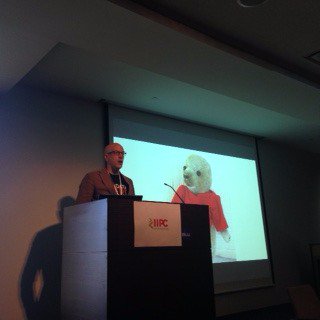 |
| Hjálmar Gíslason delivering the 2016 IIPC WAC opening keynote |
It is worth planning this early as people become unavailable surprisingly far in advance.
It could also be argued that we don't need keynotes. People aren't coming to the IIPC WAC to hear some 'rock star' presenter. The event itself is the draw. But I think a couple of keynotes really help tie the event together.
One change may be worth considering. Instead of a whole day with a single track featuring both keynotes, perhaps have multiple tracks on all days but do a single track session at the start of day one and at the end of day two that accommodates the keynotes and the welcome and wrap up talks.
When we were trying to fit in all the proposals we got for Reykjavik, we considered doing this, but the idea simply arose too late. We were unable to secure the additional space required.
Again, we need to plan early.
The General Assembly should not be a conference
The GAs have changed a lot over the years. The IIPC met in Reykjavik for the first time in 2005. Back then we didn't call the meetings "GAs", they were just meetings. And they mostly oriented around discussions. They were working meetings. And they were usually very good.
The first GA, in Paris 2007, largely retained that, despite the fact that the IIPC was already beginning to grow. There was no 'open day'.
By 2010 in Singapore, the open day was there. But in a way that made sense and it didn't overly affect the rest of the GA. I did notice, however, a marked change in the level of engagement by the attendees during sessions.
There seemed to be more people there 'just to listen'. There had always been some of those, but I found it difficult to get discussions going, where two years prior, they'd had usually been difficult to stop in order to take breaks! Not that those discussions had always been all that productive (some of it was just talk), but the atmosphere was more restrained.
At that time I was co-chair of the Harvesting Working Group (HWG) along with Lewis Crawford of the British Library. And although there was always good attendance at the HWG meetings we really struggled to engage the attendees.
Helen Hockx-Yu and Kris Carpenter, who led the Access Working Group (AWG) did a better job of this but clearly felt the same problem. Ultimately, both HWG and AWG became more of GA events than working groups and have now been decommissioned.
With larger groups and especially with many there 'just to listen' it becomes much easier to just do a series of presentations. Its safer, more predictable and when you add the pressure to fit in all the material from the CFP, it becomes inevitable.
But, in the process we have lost something.
Now that the WAC is firmly established and can serve very well for the people who 'just want to listen', I think it is time we refocus the GA on being working meetings. A venue for addressing both consortium business (like the portfolio breakout sessions in Reykjavik, but with more time!) and the work of the consortium (like the OpenWayback meeting and the Preservation and Content Development Working Group meetings in Reykjavik).
This will inevitably include some presentations (but keep them to a minimum!) and there may be some panel discussions but the overall focus should be on working meetings. Where specific topics are discussed and, as much as possible, actions are decided.
That's why I nominated the people I did for the GA Organizing Group. These are the people driving the work of the consortium. They should help form the GA agenda. At least as far as their area of responsibility is concerned.
To accommodate the less knowledgeable GA attendee (e.g. new members) it may be a good idea to schedule tutorials and/or training sessions in parallel to some of these working meetings.
I believe this can build up a more engaged community. And for those not interested in participating in specific work, the WAC will be there to provide them with an opportunity to learn and connect with other members.
This wont be an easy transition. As my experience with the HWG showed, it can be difficult to engage people. But by having a conference (and perhaps training events) to divert those just looking to learn and building sessions around specific strategic goals, I think we can bring this element of 'work' back.
And if we can't, I'm not sure we have much of a future except as a yearly conference.
April 18, 2016
A long week is over. Thank you all.
The 2016 IIPC General Assembly and Web Archiving Conference is over. Phew!
I always look forward to this event each year. It is by far the most stimulating and productive meeting/conference that I attend regularly. I believe we managed to live up to that this time.
The meeting had a wonderful Twitter back-channel that you can still review using the hashtags #iipcGA16 and #iipcWAC16.
It has been over two years since we, at the National and University Library of Iceland, offered to host the 2016 GA, and over a half year before that when the initial decision was made. Even with a 2.5 year lead time, it barely felt like enough.
I'd like to take this opportunity to thank, again, all the people who helped make last week's event a success.
First off, there is the program committee, which was very small this year, comprising, in addition to myself, (in alphabetical order) Alex Thurman (Columbia University Libraries), Gina Jones (Library of Congress), Jason Webber (IIPC PCO/British Library), Nicholas Taylor (Stanford University Libraries) and Peter Stirling (Bibliothèque nationale de France). I literally couldn't have done this without you.
I'd also like to note the contribution of our incoming PCO in this list, Olga Holownia who put in a lot of work during the conference to help make sure everything was just right for each session.
Next, I'd like to thank my colleagues at the National Library who assisted me in organizing this event and helped out during by week by handling registration, running tours etc. It was a team effort. Notable mentions to Áki Karlsson and Erla Bjarnadóttir who spent much of the week making sure that all the little details were attended to.
A big thank you to all the speakers and session moderators.
And lastly, I'd like to thank the members of the Steering Committee for being willing to entrust the single most important event of the IIPC calendar to one of the IIPC's smallest members. Indeed, doing so without the slightest hesitation.
I've learned a lot from this past week and I hope to be able to distill that experience and write it up so that next year's GA/WAC can be even better. But that will have to wait for another day and another blog post.
For now, I'll just say thanks for coming and see you all again in Lisbon for #iipcGA17 and #iipWAC17.
 | |
| Me, opening the Harvesting Tools session on Tuesday |
The meeting had a wonderful Twitter back-channel that you can still review using the hashtags #iipcGA16 and #iipcWAC16.
It has been over two years since we, at the National and University Library of Iceland, offered to host the 2016 GA, and over a half year before that when the initial decision was made. Even with a 2.5 year lead time, it barely felt like enough.
I'd like to take this opportunity to thank, again, all the people who helped make last week's event a success.
First off, there is the program committee, which was very small this year, comprising, in addition to myself, (in alphabetical order) Alex Thurman (Columbia University Libraries), Gina Jones (Library of Congress), Jason Webber (IIPC PCO/British Library), Nicholas Taylor (Stanford University Libraries) and Peter Stirling (Bibliothèque nationale de France). I literally couldn't have done this without you.
I'd also like to note the contribution of our incoming PCO in this list, Olga Holownia who put in a lot of work during the conference to help make sure everything was just right for each session.
Next, I'd like to thank my colleagues at the National Library who assisted me in organizing this event and helped out during by week by handling registration, running tours etc. It was a team effort. Notable mentions to Áki Karlsson and Erla Bjarnadóttir who spent much of the week making sure that all the little details were attended to.
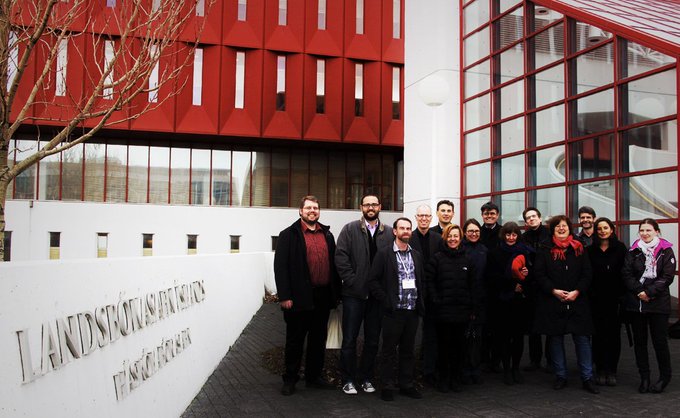 |
| The Steering Committee on Friday following the SC meeting |
And lastly, I'd like to thank the members of the Steering Committee for being willing to entrust the single most important event of the IIPC calendar to one of the IIPC's smallest members. Indeed, doing so without the slightest hesitation.
I've learned a lot from this past week and I hope to be able to distill that experience and write it up so that next year's GA/WAC can be even better. But that will have to wait for another day and another blog post.
For now, I'll just say thanks for coming and see you all again in Lisbon for #iipcGA17 and #iipWAC17.
January 29, 2016
Things to do in Iceland ...
... when you are not in a conference center
It is clear that many attendees at the IIPC GA and web archiving conference in Reykjavík next April (details) plan to extend their stay. Several have contacted me for advice on what not to miss. So, I figured I'd write something up for all to see.
The following is far from exhaustive or authoritative. It largely reflects my personal taste and may have glaring omissions. It also probably reflects my memory as well!
Reykjavík
Downtown Reykjavík has many interesting sights, museums and attractions. Not to mention shops, bars and restaurants. Of particular note is Hallgrímskirkja which rises up over the heart of city and right outside it is the statue of Leif Eriksson. The Pearl dominates the skyline a bit further south, there are stunning views to be had from its observation deck. In the heart of the city you'll find Alþingishúsið (Parliment building), city hall, the old harbor, Harpa (concert hall) and many other notable buildings and sights.A bit further afield you'll find Höfði and the Sólfar sculpture. Sólfarið is without a question my favorite public sculpture, anywhere.
There are a large number of museums in Reykjavík. Ranging from the what-you'd-expect to the downright-weird.
Thanks to abundant geothermal energy, you'll find heated, open air, public swimming pools open year round. I highly recommend a visit to one of them. Reykjavík's most prominent public pool is Laugardalslaug.
Lastly, the most famous eatery in Iceland is in the heart of the city, and worth a visit, Bæjarins Beztu.
Out of Reykjavík
Just south of Reykjavík (15 minutes), in my hometown of Hafnarfjörður, you'll find a Viking Village!A bit further there is the Blue Lagoon. I highly recommend everyone try it at least once. Do note that you may need to book in advance!
And just a bit further still, you'll find the Bridge Between Continents! Okay, so the last one is a bit overwrought, but still a fun visit if you're at all into plate tectonics.
Whale watching tours are operated out of Reykjavík, even in April. You'll want some warm clothes if you go on one of those!
Probably the most popular (for good reasons) day tour out of Reykjavík is the Golden Circle. It covers Geysir, Gullfoss (Iceland's largest waterfall) and Þingvellir (the site of the original Icelandic parliament, formed in 930, it is a UNESCO World Heritrage Site). You can do the circle in a rented car and there are also numerous tour operators offering this tip and variations on it.
Driving along the southern coast on highway 1, you'll also come across many interesting town and sights. It is possible to drive as far as Jökulsárlón and back in a single day. Stopping at places like Selfoss, Vík í Mýrdal, Seljalandsfoss, Skógarfoss and Skaftafell National Park. It may be better to plan an overnight stop, however. This is an ideal route for a modest excursion as there are so many interesting sights right by the highway.
Further afield
For longer trips outside of the capitol there are too many options to count. You could go to Vestmannaeyjar, just off the south coast, or to Akureyri, the capitol of the north. A popular trip is to take highway 1 around the country (it loops around). Such a trip can be done in 3-4 days, but you'd need closer to a week to fully appreciate all the sights along the way.November 12, 2015
Workshop on Missing Warc Features
Yesterday I tweeted:
The idea for this session came to me while reviewing the various issues set forward for the WARC 1.1 review. Several of the issues/proposals were clearly important as they addressed real needs but at the same time they were nowhere near ready for standardization.
It is important that before we enshrine a solution in the standard that we mature it. This may include exploring multiple avenues to resolve the matter. At minimum it requires implementing it in the relevant tools as proof of concept.
The issues in question include:
I'd like to organize a workshop during the 2016 IIPC GA to discuss these issues. For that to become a reality I'm looking for people willing to present on one or more of these topics (or a related one that I missed). It will probably be aimed at the open days so attendance is not strictly limited to IIPC members.
The idea is that we'd have a ~10-20 minute presentation where a particular issues's problems and needs were defined and a solution proposed. It doesn't matter if the solution has been implemented in code. Following each presentation there would then be a discussion on the merits of the proposed solution and possible alternatives.
A minimum of three presentations would be needed to "fill up" the workshop. We should be able to fit in four.
So, that's what I'm looking for, volunteers to present one or more of these issues. Or, a related issue I've missed.
To be clear, while the idea for this workshop comes out of the WARC 1.1 work it is entirely separate from that review. By the time of the GA the WARC 1.1 revision will be all but settled. Consider this, instead, as a first possible step on the WARC 1.2 revision.
Considering a session on crawl artifacts that don't yet fit in WARCs for #iipcGA16. If you're interested in helping organize, let me know.
— Kristinn Sigurðsson (@kristsi) November 11, 2015
Possible topics include screenshots, SSL certs, HTTP 2.X and AJAX interactions. #iipcGA16
— Kristinn Sigurðsson (@kristsi) November 11, 2015
I thought I'd expand a bit on this without a 140 character limit.The idea for this session came to me while reviewing the various issues set forward for the WARC 1.1 review. Several of the issues/proposals were clearly important as they addressed real needs but at the same time they were nowhere near ready for standardization.
It is important that before we enshrine a solution in the standard that we mature it. This may include exploring multiple avenues to resolve the matter. At minimum it requires implementing it in the relevant tools as proof of concept.
The issues in question include:
- Screenshots – Crawling using browsers is becoming more common. A very useful by product of this is a screenshot of the webpage as rendered by the browser. It is, however, not clear how best to store this in a WARC. Especially not in terms of making it easily discoverable to a user of a Wayback like replay. This may also affect other types of related resources and metadata.
See further on WARC specification issue tracker: #13 #27 - HTTP 2 – The new HTTP 2 standard uses binary headers. This seems to breaks one of the expectations of WARC response records containing HTTP responses.
See further on WARC specification issue tracker: #15 - SSL certificates – Store the SSL certificates used during an HTTPS session. #12
- AJAX Interactions – #14
I'd like to organize a workshop during the 2016 IIPC GA to discuss these issues. For that to become a reality I'm looking for people willing to present on one or more of these topics (or a related one that I missed). It will probably be aimed at the open days so attendance is not strictly limited to IIPC members.
The idea is that we'd have a ~10-20 minute presentation where a particular issues's problems and needs were defined and a solution proposed. It doesn't matter if the solution has been implemented in code. Following each presentation there would then be a discussion on the merits of the proposed solution and possible alternatives.
A minimum of three presentations would be needed to "fill up" the workshop. We should be able to fit in four.
So, that's what I'm looking for, volunteers to present one or more of these issues. Or, a related issue I've missed.
To be clear, while the idea for this workshop comes out of the WARC 1.1 work it is entirely separate from that review. By the time of the GA the WARC 1.1 revision will be all but settled. Consider this, instead, as a first possible step on the WARC 1.2 revision.
June 30, 2015
Web archiving APIs - a start
Even though it didn't feature heavily on the official agenda, the topic of web archive APIs repeatedly came up during the last IIPC GA in Stanford. This is an understandable desire as the use of APIs enables interoperability amongst different tools. This, in theory, allows you to build (many) narrow purpose tools and then have them work, seamlessly, together. No more monolithic behemoths that are a pain to maintain.
In fact, we already have one web archive "API" in wide use; the WARC file format. While technically not an "application programming interface" it serves the same fundamental purpose, to enable interoperability. It has decoupled harvesters (e.g. Heritrix) from replay systems (e.g. OpenWayback) and both of those from analytical/data mining software etc.
Overall I'd say the WARC format has been a success, albeit not without its flaws. More on that later.
So, now there is interest in defining more "APIs". Indeed, there was a survey, recently, about the possibility of setting up a special "APIs Working Group" within the IIPC.
What I find missing from this conversations is, what are these APIs? Which facets of web archiving are amicable to being formalized in this manner?
We do have a few informal "APIs" floating around. The CDX file format is one. The Memento protocol is another. Cleaning up and formalizing an existing 'defacto' API avoids the pitfall of creating an API that entirely fails to work in the "real world."
To understand this, lets go back the WARC format. It was an extension of the ARC file format developed by the Internet Archive. In drafting the WARC standard, the lessons of the ARC file format were used and most of the ARC file format's short comings were addressed.
Predictably, where the WARC format has shown weakness is in areas that ARC did not address at all. For example in handling duplicate records. In those areas, wrong assumptions were made due to lack of experience. This in turn, for example, significantly delayed the widespread use of deduplication.
The best APIs/protocols/standards emerge from hard won experience. I would argue very strongly against developing any API from the top down.
With that in mind, there are two possible APIs I believe are ready to be made more formal.
The first is the current "CDX Server protocol". The CDX Server is a component within OpenWayback that resolves URI+timestamp requests into stored resources (either a single one or a range depending on the nature of the query). Note, that a "CDX Server" need not use a CDX style index. That is merely how it is now. This is a protocol for separating the user interface of a replay tool (like OpenWayback) from its the index. Lets call it Web Archive Query Protocol, WAQP, for now.
Pywb, another replay tool, uses almost the same protocol in its implementation. With a well defined WAQP, you might be able to use Pywb front end (display) with the OpenWayback back end (CDX server) or the other way around.
With a well defined WAQP, the job of indexing WARCs would be become independent of the job of replaying web archives by rewriting URLs. This would make it much easier to develop new versions of either type of software.
The other API is a bit more speculative. Web archiving proxies now exist and serve a very useful function. If a standard API was established for how these proxies interacted with the software driving the harvesting activity, it would be much easier to pair the two together. This API could possibly be built on top of existing proxy protocols.
I don't mean to imply that this is the definitive final list of web archiving APIs to be developed. These are simply two areas I believe are ready to be formalized and where doing so is likely to be of benefit in the near term.
So, how best to proceed? As noted earlier, the idea has been floated to establish a special APIs working group. On the other hand, there is already precedent for running API development through the existing working groups (WARC was developed within the harvesting working group).
My personal opinion is that once a specific API has been identified as a goal, a special working group (or task force or whatever name you'd like to give it) be formed around that one API. This working groups would than disband once the job is done. Such groups could be reformed if there is a need for a significant revision.
It is also important that any API formalization be done in close cooperation with at least some of the relevant tool maintainers. APIs that are not implemented are, after all, useless.
In fact, we already have one web archive "API" in wide use; the WARC file format. While technically not an "application programming interface" it serves the same fundamental purpose, to enable interoperability. It has decoupled harvesters (e.g. Heritrix) from replay systems (e.g. OpenWayback) and both of those from analytical/data mining software etc.
Overall I'd say the WARC format has been a success, albeit not without its flaws. More on that later.
So, now there is interest in defining more "APIs". Indeed, there was a survey, recently, about the possibility of setting up a special "APIs Working Group" within the IIPC.
What I find missing from this conversations is, what are these APIs? Which facets of web archiving are amicable to being formalized in this manner?
We do have a few informal "APIs" floating around. The CDX file format is one. The Memento protocol is another. Cleaning up and formalizing an existing 'defacto' API avoids the pitfall of creating an API that entirely fails to work in the "real world."
To understand this, lets go back the WARC format. It was an extension of the ARC file format developed by the Internet Archive. In drafting the WARC standard, the lessons of the ARC file format were used and most of the ARC file format's short comings were addressed.
Predictably, where the WARC format has shown weakness is in areas that ARC did not address at all. For example in handling duplicate records. In those areas, wrong assumptions were made due to lack of experience. This in turn, for example, significantly delayed the widespread use of deduplication.
The best APIs/protocols/standards emerge from hard won experience. I would argue very strongly against developing any API from the top down.
With that in mind, there are two possible APIs I believe are ready to be made more formal.
The first is the current "CDX Server protocol". The CDX Server is a component within OpenWayback that resolves URI+timestamp requests into stored resources (either a single one or a range depending on the nature of the query). Note, that a "CDX Server" need not use a CDX style index. That is merely how it is now. This is a protocol for separating the user interface of a replay tool (like OpenWayback) from its the index. Lets call it Web Archive Query Protocol, WAQP, for now.
Pywb, another replay tool, uses almost the same protocol in its implementation. With a well defined WAQP, you might be able to use Pywb front end (display) with the OpenWayback back end (CDX server) or the other way around.
With a well defined WAQP, the job of indexing WARCs would be become independent of the job of replaying web archives by rewriting URLs. This would make it much easier to develop new versions of either type of software.
The other API is a bit more speculative. Web archiving proxies now exist and serve a very useful function. If a standard API was established for how these proxies interacted with the software driving the harvesting activity, it would be much easier to pair the two together. This API could possibly be built on top of existing proxy protocols.
I don't mean to imply that this is the definitive final list of web archiving APIs to be developed. These are simply two areas I believe are ready to be formalized and where doing so is likely to be of benefit in the near term.
So, how best to proceed? As noted earlier, the idea has been floated to establish a special APIs working group. On the other hand, there is already precedent for running API development through the existing working groups (WARC was developed within the harvesting working group).
My personal opinion is that once a specific API has been identified as a goal, a special working group (or task force or whatever name you'd like to give it) be formed around that one API. This working groups would than disband once the job is done. Such groups could be reformed if there is a need for a significant revision.
It is also important that any API formalization be done in close cooperation with at least some of the relevant tool maintainers. APIs that are not implemented are, after all, useless.
June 24, 2015
OpenWayback 2.2.0
OpenWayback 2.2.0 was recently released. This marks OpenWayback's third release since becoming a ward of the IIPC in late 2013. This is a fairly modest update and reflects our desire to make frequent, modest sized releases. A few things are still worth pointing out.
First, as of this release, OpenWayback requires Java 7. Java 7 has been out for four years and Java 6 has not been publicly updated in over two years. It is time to move on.
Second, OpenWayback now officially supports internationalized domain names. I.e. domain names containing non-ASCII characters.
Third, UI localization has been much improved. It should now be possible to translate the entire interface without having to mess with the JSP files and otherwise "go under the hood".
And the last thing I'll mention is the new WatchedCDXSource which removes the need to enumerate all the CDX files you wish to use. Simply designate a folder and OpenWayback will pick up all the CDX files in it.
The road to here hasn't been easy, but it is encouraging to see that the number of people involved is slowly, but surely rising. For the 2.2.0 release, we had code contributions from Roger Coram (BL), Lauren Ko (UNT), John Erik Halse (NLN), Sawood Alam (ODU), Mohamed Elsayed (BA) and myself in addition to the IIPC-payed-for work by Roger Mathisen (NLN). Even more people were involved in reporting issues, managing the project and testing the release candidate. My thanks to everyone who helped out.
And going forward, we are certainly going to need people to help out.
Version 2.3.0 of OpenWayback will be another modest bundle of fixes and minor features. We hope it will be ready in September (or so). There are already 10 issues open for it as I write this.
But, we also have larger ambitions. Enter version 3.0.0. It will be developed in parallel with 2.3.0 and aims to make some big changes. Breaking changes. OpenWayback is built on an aging codebase, almost a decade old at this point. To move forward, some big changes need to be made.
The exact features to be implemented will likely shift as work progresses but we are going to increase modularity by pushing the CDXServer front and center and removing the legacy resource stores. In addition to simplifying the codebase, this fits very nicely with the talk at the last GA about APIs.
We'll also be looking at redoing the user interface using iFrames and providing insight into the temporal drift of the page being viewed. The planned issues are available on GitHub. The list is far from locked and we welcome additional input on which features to work on.
We welcome additional work on those features even more!
I'd like to wrap this up with a call to action. We need a reasonably large community around the project to sustain it. Whether it's testing and bug reporting, occasional development work or taking on more by becoming one of our core developers, your help is both needed and appreciated.
If you'd like to become involved, you can simply join the conversation on the OpenWayback GitHub page. Anyone can open new issues and post comments on existing issues. You can also join the OpenWayback developers mailing list.
---
This post was written for the IIPC blog.
March 18, 2015
Preservation Working Group Web Archiving Deduplication Survey
The IIPC Preservation Working Group is conducting a survey of member institutions deduplication activities. If you or your institution hasn't yet responded, I urge you to do so. Right now. Don't worry, I'll wait.
Answering the survey for my own institution brought up a few things I'd like to go into in greater detail than was possible in the survey.
What kind of content do you deduplicate?
We've been doing deduplication for over nine years. In that time we've done some analysis on this from time to time. Most recently last December which led to this blog posts on deduplication of text based data.
Ultimately, it boils down to a trade off between the impact the deduplication has on crawl rate and the potential savings in terms of storage. For our large, thrice yearly crawls we're now only excluding data whose content type equals "text/html".
HTML documents make up over half of all documents, but they are generally small, frequently created dynamically and compress easily. In other words, they make the deduplication index much bigger while not contributing much to deduplication space saving.
Despite this, for our weekly and other focused crawls, we do deduplicate on all content types as those crawls' speeds are usually dictated by politeness rules. Deduplicating on all content types thus comes at near zero cost. Also the more frequent crawl schedules means that there is, relatively, more savings to be had from deduplicating on HTML than in less frequent crawls.
One aspect that the survey didn't tackle, was on which protocols and response types we deduplicate. We currently do not deduplicate on FTP (we do not crawl much FTP content). We also only deduplicate on HTTP 200 responses. I plan to look into deduplicating on 404 responses in the near future. Most other response types have an empty or negligible payload.
If you deduplicate, do you deduplicate based on URL, hash or both?
Historically, we've only done URL based deduplication. Starting with the last domain crawl of 2014, we've begun rolling out hash based deduplication. This is done fairly conservatively with the same URL being chosen as the 'original' when possible. This has an impact on crawl speeds and we may revise this policy as we gain more confidence in hash based deduplication.
The reason why hash based deduplication hasn't been used earlier is all about tool support. OpenWayback has never had a secondary index to look up based on hashes. It wasn't until we introduced additional data into the WARC revisit records that this was possible. This has now been implemented by both Heritrix and OpenWayback making hash based deduplication viable.
The additional savings gained by hash based deduplication are modest or about 10% in our crawls. In certain circumstances, however, they may help deal with unfortunate website design choices.
For example, one media site we crawl recently started adding a time code to their videos' URLs so their JavaScript player could skip to the right place in them. The time code is an URL parameter (e.g. "video.mp4?t=100") that doesn't affect the downloaded content at all. It is merely a hint to the JavaScript player. With crawl time hash based deduplication, it is possible to store each video only once.
How do you deduplicate?
This question and the next few after it addresses the same issues I discussed in my blog post about the downsides of web archive deduplication.
The primary motivation behind our deduplication effort is to save on storage. We wouldn't be able to crawl nearly as often without it. Moreover, our focused crawls would be impossible without deduplication as we discard as much as 90% of data as duplicates in such crawls.
Even doing a single 'clean' (non deduplicated) crawl every two years would mean we had to go from three to two crawls a year due to our storage budget. So we don't do that.
It's an arguable tradeoff. Certainly, it is going to be more difficult for us to break out discrete crawls due to the reduplication problem. Ultimately it comes down to the fact that what we don't crawl now is lost to us, forever. The reduplication problem can be left to the future.
That just leaves...
Do you see any preservation risks related to deduplication?
Do you see any preservation risks related to deduplication and the number of W/ARC copies the institution should keep?
In general, yes, there is a risk. Any data loss has the potential to affect a larger part of your archive.
To make matters worse, if you lose a WARC you may not be able to accurately judge the effects of its loss! Unless you have an index of all the original records that all the revisit records point to, you may need to scan all the WARCs that could potentially contain revisit records pointing to the lost WARC.
This is clearly a risk.
You also can't easily mitigate it by having some highly cited original records be stored with additional copies as those original records are scattered far and wide within your archive. Again, you'd need some kind of index of revisit references.
We address this simply by having three full copies (two of which are, in turn, stored on RAID based media). You may ask, but doesn't that negate some of the monetary savings of deduplication if you then store it multiple times? True, but we are going to want at least two copies at a minimum. Additionally, only one copy need be on a high speed, high availability system (we have two copies on such systems) for access. Further copies can be stored in slower or offline media which tends to be much cheaper.
Whether three (technically 3.5 due to RAID) is enough is then the question. I don't have a definitive answer. Do you?
Answering the survey for my own institution brought up a few things I'd like to go into in greater detail than was possible in the survey.
What kind of content do you deduplicate?
We've been doing deduplication for over nine years. In that time we've done some analysis on this from time to time. Most recently last December which led to this blog posts on deduplication of text based data.
Ultimately, it boils down to a trade off between the impact the deduplication has on crawl rate and the potential savings in terms of storage. For our large, thrice yearly crawls we're now only excluding data whose content type equals "text/html".
HTML documents make up over half of all documents, but they are generally small, frequently created dynamically and compress easily. In other words, they make the deduplication index much bigger while not contributing much to deduplication space saving.
Despite this, for our weekly and other focused crawls, we do deduplicate on all content types as those crawls' speeds are usually dictated by politeness rules. Deduplicating on all content types thus comes at near zero cost. Also the more frequent crawl schedules means that there is, relatively, more savings to be had from deduplicating on HTML than in less frequent crawls.
One aspect that the survey didn't tackle, was on which protocols and response types we deduplicate. We currently do not deduplicate on FTP (we do not crawl much FTP content). We also only deduplicate on HTTP 200 responses. I plan to look into deduplicating on 404 responses in the near future. Most other response types have an empty or negligible payload.
If you deduplicate, do you deduplicate based on URL, hash or both?
Historically, we've only done URL based deduplication. Starting with the last domain crawl of 2014, we've begun rolling out hash based deduplication. This is done fairly conservatively with the same URL being chosen as the 'original' when possible. This has an impact on crawl speeds and we may revise this policy as we gain more confidence in hash based deduplication.
The reason why hash based deduplication hasn't been used earlier is all about tool support. OpenWayback has never had a secondary index to look up based on hashes. It wasn't until we introduced additional data into the WARC revisit records that this was possible. This has now been implemented by both Heritrix and OpenWayback making hash based deduplication viable.
The additional savings gained by hash based deduplication are modest or about 10% in our crawls. In certain circumstances, however, they may help deal with unfortunate website design choices.
For example, one media site we crawl recently started adding a time code to their videos' URLs so their JavaScript player could skip to the right place in them. The time code is an URL parameter (e.g. "video.mp4?t=100") that doesn't affect the downloaded content at all. It is merely a hint to the JavaScript player. With crawl time hash based deduplication, it is possible to store each video only once.
How do you deduplicate?
This question and the next few after it addresses the same issues I discussed in my blog post about the downsides of web archive deduplication.
The primary motivation behind our deduplication effort is to save on storage. We wouldn't be able to crawl nearly as often without it. Moreover, our focused crawls would be impossible without deduplication as we discard as much as 90% of data as duplicates in such crawls.
Even doing a single 'clean' (non deduplicated) crawl every two years would mean we had to go from three to two crawls a year due to our storage budget. So we don't do that.
It's an arguable tradeoff. Certainly, it is going to be more difficult for us to break out discrete crawls due to the reduplication problem. Ultimately it comes down to the fact that what we don't crawl now is lost to us, forever. The reduplication problem can be left to the future.
That just leaves...
Do you see any preservation risks related to deduplication?
Do you see any preservation risks related to deduplication and the number of W/ARC copies the institution should keep?
In general, yes, there is a risk. Any data loss has the potential to affect a larger part of your archive.
To make matters worse, if you lose a WARC you may not be able to accurately judge the effects of its loss! Unless you have an index of all the original records that all the revisit records point to, you may need to scan all the WARCs that could potentially contain revisit records pointing to the lost WARC.
This is clearly a risk.
You also can't easily mitigate it by having some highly cited original records be stored with additional copies as those original records are scattered far and wide within your archive. Again, you'd need some kind of index of revisit references.
We address this simply by having three full copies (two of which are, in turn, stored on RAID based media). You may ask, but doesn't that negate some of the monetary savings of deduplication if you then store it multiple times? True, but we are going to want at least two copies at a minimum. Additionally, only one copy need be on a high speed, high availability system (we have two copies on such systems) for access. Further copies can be stored in slower or offline media which tends to be much cheaper.
Whether three (technically 3.5 due to RAID) is enough is then the question. I don't have a definitive answer. Do you?
January 19, 2015
The First IIPC Technical Training Workshop
It has always been interesting to me how often a chance remark will lead to big things within the IIPC. A stray thought, given voice during a coffee break or dinner at a general assembly, can hit a resonance and lead to something new, something exciting.
So it was with the first IIPC technical training workshop. It started off as an off the cuff joke at last year's Paris GA, about having a 'Heritrix DecideRule party'. It struck a nerve, and it also quickly snowballed to include an 'OpenWayback upgradathon' and a 'SolrJam'.
The more we talked about this, the more convinced I became that this was a good idea. To have a hands on workshop, where IIPC members could send staff for practical training in these tools. Fortunately, Helen Hockx-Yu of the British Library shared this conviction. Even more fortunately, the IIPC Steering Committee wholeheartedly supported the idea. Most fortunate of all, the BL was ready, willing and able to host such an event.
So, last week, on a rather dreary January morning around thirty web archiving professionals, from as far away as New Zealand, gathered outside the British Library in London and waited for the doors to open. Everyone eager to learn more about Heritrix, OpenWayback and Solr.
Day one was dedicated to traditional, presentation oriented, dissemination of knowledge. On hand were several invited experts on each topic. In the morning the basics fundamentals of the three tools were discussed, with more in depth topics after lunch. Roger Coram (BL) and I were responsible for covering Heritrix. Roger discussed the basics of Heritrix DecideRules and I covered other core features, notably sheet overlays in the morning. The afternoon focused on Heritrix's REST API, deduplication at crawl time, and writing your own Heritrix modules.
There is no need for me to repeat all of the topics. The entire first day was filmed and made available online, in IIPC's YouTube channel.
Day one went well, but it wasn't radically different from what we have done before at GAs. It was days two and three that made this meeting unique.
For the later two days only a very loose agenda was provided. A list of tasks related to each tool, varying in complexity. Attendees choose tasks according to their interests and level of technical know-how. Some installed and ran their very first Heritrix crawl or set up their first OpenWayback instance. I set up Solr via the BL's webarchive-discovery and set it to indexing one of our collection.
Others focused on more advanced tasks involving Heritrix sheet overlays and REST API, OpenWayback WAR overlays and CDX generation or ... I really don't know what the advanced Solr tasks were. I was just happy to get the basic indexing up and running.
The 'experts' who did presentations on day one, were, of course, on hand during days two and three to assist. I found this to be a very good model. Impromptu presentations were made on specific topics and the specific issues of different attendees could be addressed. I learned a fair amount about how other IIPC members actually conduct their crawls. There is nothing like hands-on knowledge. I think both experts and attendees got a lot out of it.
It was almost sad to see the three day event come to an end.
So, overall, a success. Definitely meriting an encore.
That isn't to say it was perfect, there is always room for improvement. Given a bit more lead-up time, it would have been possible to get a firmer idea of the actual interests of the attendees. For this workshop there was a bit of guess work. I think we were in the ballpark, but we can do better next time. It would also have been useful to have better developed tasks for the less experienced attendees.
So, will there be an opportunity to improve? I certainly hope so. We will need to decide where (London again or elsewhere) and when (same time next year or ...). The final decision will then be up to the IIPC Steering Committee. All I can say, is that I'm for it and I hope we can make this an annual event. A sort of counter-point to the GA.
We'll see.
Finally, I'd like to thank Helen and the British Library for their role as host and all of our experts for their contribution.
So it was with the first IIPC technical training workshop. It started off as an off the cuff joke at last year's Paris GA, about having a 'Heritrix DecideRule party'. It struck a nerve, and it also quickly snowballed to include an 'OpenWayback upgradathon' and a 'SolrJam'.
The more we talked about this, the more convinced I became that this was a good idea. To have a hands on workshop, where IIPC members could send staff for practical training in these tools. Fortunately, Helen Hockx-Yu of the British Library shared this conviction. Even more fortunately, the IIPC Steering Committee wholeheartedly supported the idea. Most fortunate of all, the BL was ready, willing and able to host such an event.
So, last week, on a rather dreary January morning around thirty web archiving professionals, from as far away as New Zealand, gathered outside the British Library in London and waited for the doors to open. Everyone eager to learn more about Heritrix, OpenWayback and Solr.
Day one was dedicated to traditional, presentation oriented, dissemination of knowledge. On hand were several invited experts on each topic. In the morning the basics fundamentals of the three tools were discussed, with more in depth topics after lunch. Roger Coram (BL) and I were responsible for covering Heritrix. Roger discussed the basics of Heritrix DecideRules and I covered other core features, notably sheet overlays in the morning. The afternoon focused on Heritrix's REST API, deduplication at crawl time, and writing your own Heritrix modules.
There is no need for me to repeat all of the topics. The entire first day was filmed and made available online, in IIPC's YouTube channel.
Day one went well, but it wasn't radically different from what we have done before at GAs. It was days two and three that made this meeting unique.
For the later two days only a very loose agenda was provided. A list of tasks related to each tool, varying in complexity. Attendees choose tasks according to their interests and level of technical know-how. Some installed and ran their very first Heritrix crawl or set up their first OpenWayback instance. I set up Solr via the BL's webarchive-discovery and set it to indexing one of our collection.
Others focused on more advanced tasks involving Heritrix sheet overlays and REST API, OpenWayback WAR overlays and CDX generation or ... I really don't know what the advanced Solr tasks were. I was just happy to get the basic indexing up and running.
The 'experts' who did presentations on day one, were, of course, on hand during days two and three to assist. I found this to be a very good model. Impromptu presentations were made on specific topics and the specific issues of different attendees could be addressed. I learned a fair amount about how other IIPC members actually conduct their crawls. There is nothing like hands-on knowledge. I think both experts and attendees got a lot out of it.
It was almost sad to see the three day event come to an end.
So, overall, a success. Definitely meriting an encore.
That isn't to say it was perfect, there is always room for improvement. Given a bit more lead-up time, it would have been possible to get a firmer idea of the actual interests of the attendees. For this workshop there was a bit of guess work. I think we were in the ballpark, but we can do better next time. It would also have been useful to have better developed tasks for the less experienced attendees.
So, will there be an opportunity to improve? I certainly hope so. We will need to decide where (London again or elsewhere) and when (same time next year or ...). The final decision will then be up to the IIPC Steering Committee. All I can say, is that I'm for it and I hope we can make this an annual event. A sort of counter-point to the GA.
We'll see.
Finally, I'd like to thank Helen and the British Library for their role as host and all of our experts for their contribution.
Subscribe to:
Posts (Atom)