January 29, 2016

Things to do in Iceland ...

... when you are not in a conference center


It is clear that many attendees at the IIPC GA and web archiving conference in Reykjavík next April (details) plan to extend their stay. Several have contacted me for advice on what not to miss. So, I figured I'd write something up for all to see.

The following is far from exhaustive or authoritative. It largely reflects my personal taste and may have glaring omissions. It also probably reflects my memory as well!

Reykjavík

Downtown Reykjavík has many interesting sights, museums and attractions. Not to mention shops, bars and restaurants. Of particular note is Hallgrímskirkja which rises up over the heart of city and right outside it is the statue of Leif Eriksson. The Pearl dominates the skyline a bit further south, there are stunning views to be had from its observation deck. In the heart of the city you'll find Alþingishúsið (Parliment building), city hall, the old harbor, Harpa (concert hall) and many other notable buildings and sights.

A bit further afield you'll find Höfði and the Sólfar sculpture. Sólfarið is without a question my favorite public sculpture, anywhere.

There are a large number of museums in Reykjavík. Ranging from the what-you'd-expect to the downright-weird.

Thanks to abundant geothermal energy, you'll find heated, open air, public swimming pools open year round. I highly recommend a visit to one of them. Reykjavík's most prominent public pool is Laugardalslaug.

Lastly, the most famous eatery in Iceland is in the heart of the city, and worth a visit, Bæjarins Beztu.

Out of Reykjavík

Just south of Reykjavík (15 minutes), in my hometown of Hafnarfjörður, you'll find a Viking Village!

A bit further there is the Blue Lagoon. I highly recommend everyone try it at least once. Do note that you may need to book in advance!

And just a bit further still, you'll find the Bridge Between Continents! Okay, so the last one is a bit overwrought, but still a fun visit if you're at all into plate tectonics.

Whale watching tours are operated out of Reykjavík, even in April. You'll want some warm clothes if you go on one of those!

Probably the most popular (for good reasons) day tour out of Reykjavík is the Golden Circle. It covers Geysir, Gullfoss (Iceland's largest waterfall) and Þingvellir (the site of the original Icelandic parliament, formed in 930, it is a UNESCO World Heritrage Site). You can do the circle in a rented car and there are also numerous tour operators offering this tip and variations on it.

Driving along the southern coast on highway 1, you'll also come across many interesting town and sights. It is possible to drive as far as Jökulsárlón and back in a single day. Stopping at places like Selfoss, Vík í Mýrdal, Seljalandsfoss, Skógarfoss and Skaftafell National Park. It may be better to plan an overnight stop, however. This is an ideal route for a modest excursion as there are so many interesting sights right by the highway.

Further afield

For longer trips outside of the capitol there are too many options to count. You could go to Vestmannaeyjar, just off the south coast, or to Akureyri, the capitol of the north. A popular trip is to take highway 1 around the country (it loops around). Such a trip can be done in 3-4 days, but you'd need closer to a week to fully appreciate all the sights along the way.


January 28, 2016

To ZIP or not to ZIP, that is the (web archiving) question

Do you use uncompressed (W)ARC files?

It is hard to imagine why you would want to store the material uncompressed. After all, web archives are big. Compression saves space and space is money.

While this seems straightforward it is worth examining some of the assumptions made here and considering what trade-offs we may be making.

Lets start by consider that a lot of the files on the Internet are already compressed. Images, audio and video files as well as almost every file format for "large data" is compressed. Sometimes simply by wrapping everything in a ZIP container (e.g. EPUB). There is very little additional benefit gained from compressing these files again (it may even increase the size very slightly).

For some, highly specific crawls, it is possible that compression will accomplish very little.

But it is also true that compression costs very little. We'll get back to that point in a bit.

For most general crawls, the amount of HTML, CSS, JavaScript and various other highly compressible material will make up a substantial portion of the overall data. Those files may be smaller, but there are a lot more of them. Especially, automatically generated HTML pages and other crawler traps that are impossible to avoid entirely.

In our domain crawls, HTML documents alone typically make up around a quarter of the total data downloaded. Given that we then deduplicate images, videos and other, largely static, file formats, HTML files' share in the overall data needing to be stored is even greater. Typically approaching half!

Given that these text files compress heavily (by 70-80% usually), tremendous storage savings can be realized using compression. In practice, our domain crawls compressed size is usually about 60% of the uncompressed size (after deduplication).

More frequently run crawls (with higher levels of deduplication) will benefit even more. Our weekly crawls' compressed size is usually closer to 35-40% of the uncompressed volume (after deduplication discards about three quarters of the crawled data).

So you can save anywhere from ten to sixty percent of the storage needed, depending on the types of crawling you do. But at what cost?

On the crawler side the limiting factor is usually disk or network access. Memory is also sometimes a bottleneck. CPU cycles are rarely an issue. Thus the additional overhead of compressing a file, as it is written to disk, is trivial.

On the access side, you also largely find that CPU isn't a limiting factor. The bottleneck is disk access. And here compression can actually help! It probably doesn't make much difference when only serving up one small slice of a WARC but when processing entire WARCs it will take less time to lift them off of the slow HDD if the file is smaller. The additional overhead of decompression is insignificant in this scenario except in highly specific circumstances where CPU is very limited (but why would you process entire WARCs in such an environment).

So, you save space (and money!) and performance is barely affected. It seems like there is no good reason to not compress your (W)ARCs.

But, there may just be one, HTTP Range Requests.

To handle an HTTP Range Request a replay tool using compressed (W)ARCs will have to access a WARC record and then decompress the entire payload (or at least from start and as far as needed). If uncompressed, the replay tool could simply locate the start of the record and then skip the required number of bytes.

This only affects large files and is probably most evident when replaying video files. User's may wish to skip ahead etc. and that is implemented via range requests. Imagine the benefit when skipping to the last few minutes of a movie that is 10 GB on disk!

Thus, it seems to me that a hybrid solution may be the best course of action. Compress everything except files whose content type indicates an already compressed format. Configure it to compress when in doubt. It may also be best to compress files under a certain size threshold due to headers being compressed. That would need to be evaluated.

Unfortunately, you can't alternate compressed and uncompressed records in a GZ file such as (W)ARC. But it is fairly simple to configure the crawler to use separate output files for these content types. Most crawls generate more than one (W)ARC anyway.

Not only would this resolve the HTTP Range Request issue, it would also avoid a lot of pointless compression/uncompression work being done.

November 12, 2015

Workshop on Missing Warc Features

Yesterday I tweeted:
I thought I'd expand a bit on this without a 140 character limit.

The idea for this session came to me while reviewing the various issues set forward for the WARC 1.1 review. Several of the issues/proposals were clearly important as they addressed real needs but at the same time they were nowhere near ready for standardization.

It is important that before we enshrine a solution in the standard that we mature it. This may include exploring multiple avenues to resolve the matter. At minimum it requires implementing it in the relevant tools as proof of concept.

The issues in question include:
  • Screenshots – Crawling using browsers is becoming more common. A very useful by product of this is a screenshot of the webpage as rendered by the browser. It is, however, not clear how best to store this in a WARC. Especially not in terms of making it easily discoverable to a user of a Wayback like replay. This may also affect other types of related resources and metadata.
    See further on WARC specification issue tracker: #13 #27
  • HTTP 2 – The new HTTP 2 standard uses binary headers. This seems to breaks one of the expectations of WARC response records containing HTTP responses.
    See further on WARC specification issue tracker: #15
  • SSL certificates – Store the SSL certificates used during an HTTPS session. #12
  • AJAX Interactions – #14
The above list is unlikely to be exhaustive. It merely enumerates the issues that I'm currently aware of.

I'd like to organize a workshop during the 2016 IIPC GA to discuss these issues. For that to become a reality I'm looking for people willing to present on one or more of these topics (or a related one that I missed). It will probably be aimed at the open days so attendance is not strictly limited to IIPC members.

The idea is that we'd have a ~10-20 minute presentation where a particular issues's problems and needs were defined and a solution proposed. It doesn't matter if the solution has been implemented in code. Following each presentation there would then be a discussion on the merits of the proposed solution and possible alternatives.

A minimum of three presentations would be needed to "fill up" the workshop. We should be able to fit in four.

So, that's what I'm looking for, volunteers to present one or more of these issues. Or, a related issue I've missed.

To be clear, while the idea for this workshop comes out of the WARC 1.1 work it is entirely separate from that review. By the time of the GA the WARC 1.1 revision will be all but settled. Consider this, instead, as a first possible step on the WARC 1.2 revision.

September 15, 2015

Looking For Stability In Heritrix Releases

Which version of Heritrix do you use?

If the answer is version 3.3.0-LBS-2015-01 then you probably already know where I'm going with this post and may want to skip to the proposed solution.  

3.3.0-LBS-2015-01 is a version of Heritrix that I "made" and currently use because there isn't a "proper" 3.3.0 release. I know of a couple of other institutions that have taken advantage of it.

The Problem (My Experience)


The last proper release of Heritrix (i.e. non-SNAPSHOT release that got pushed to a public Maven repo, even if just the Internet Archive one) that I could use was 3.1.0-RC1. There were regression bugs in both 3.1.0 and 3.2.0 that kept me from using them.

After 3.2.0 came out the main bug keeping me from upgrading was fixed. Then a big change to how revisit records were created was merged in and it was definitely time for me to stop using a 4 year old version. Unfortunately, stable releases had now mostly gone away. Even when a release is made (as I discovered with 3.1.0 and 3.2.0) they may only be "stable" for those making the release.

So, I started working with the "unstable" SNAPSHOT builds of the unreleased 3.3.0 version. This, however presented some issues. I bundle Heritrix with a few customizations and crawl job profiles. This is done via a Maven build process. Without a stable release, I'd run the risk that a change to Heritrix will cause my internal build to create something that no longer works. It also makes it impossible to release stable builds of tools that rely on new features in Heritrix 3.3.0. Thus no stable releases for the DeDuplicator or CrawlRSS. Both are way overdue.

Late last year, after getting a very nasty bug fixed in Heritrix, I spent a good while testing it and making sure no further bugs interfered with my jobs. I discovered a few minor flaws and wound up creating a fork that contained fixes for these flaws. Realizing I now had something that was as close to a "stable" build as I was likely to see, I dubbed it Heritrix version 3.3.0-LBS-2014-03 (LBS is the Icelandic abbreviation of the library's name and 2014-03 is the domain crawl it was made for).

The fork is still available on GitHub. More importantly, this version was built and deployed to our in-house Maven repo. It doesn't solve the issue of the open tools we have but for internal projects, we now had a proper release to build against.

You can see here all the commits the separate 3.2.0 and 3.3.0-LBS-2014-03 (there are a lot!).

Which brings us to 3.3.0-LBS-2015-01. When getting ready for the first crawl of this year I realized that the issues I'd had were now resolved, plus a few more things had been fixes (full list of commits). So, I created up a new fork and, again, put it through some testing. When it came up clean I released it internally as 3.3.0-LBS-2015-01. It's now used for all crawling at the library.

This sorta works for me. But it isn't really a good model for a widely used piece of software. The unreleased 3.3.0 version contains significant fixes and improvements. Getting people stuck on 3.2.0 or forcing them to use a non-stable release isn't good. And, while anyone may use my build, doing so requires a bit of know-how and there still isn't any promise of it being stable in general just because it is stable for me. This was clearly illustrated with the 3.1.0 and 3.2.0 releases which were stable for IA, but not for me.

Stable releases require some quality assurance.

Proposed Solution


What I'd really like to see is an initiative of multiple Heritrix users (be they individuals or institutions). These would come together, one or twice a year, create a release candidate and test it based on each user's particular needs. This would mostly entail running each party's usual crawls and looking for anything abnormal.

Serious regressions would either lead to fixes, rollback of features or (in dire cases) cancelling for the release. Once everyone signs off, a new release is minted and pushed to a public Maven repo.

The focus here is primarily on testing. While there might be a bit of development work to fix a bug that is discovered, the focus here is primarily on vetting that the proposed release does not contain any notable regressions.

By having multiple parties, each running the candidate build through their own workflow, the odds are greatly improved that we'll catch any serious issues. Of course, this could be done by a dedicated QA team. But the odds of putting that together is small so we must make do.

I'd love if the Internet Archive (IA) was party to this or even took over leading it. But, they aren't essential. It is perfectly feasible to alter the "group ID" and release a version under another "flag", as it were, if IA proves uninterested.

Again, to be clear, this is not an effort to set up a development effort around Heritrix, like the IIPC did for OpenWayback. This is just focused on getting regular stable builds released based on the latest code. Period.


Sign up 


If the above sounds good and you'd like to participate, by all means get in touch. In comments below, on Twitter or e-mail.

At minimum you must be willing to do the following once or twice a year:
  • Download a specific build of Heritrix
  • Run crawls with said build that match your production crawls
  • Evaluate those crawls, looking for abnormalities and errors compared to your usual crawls
    • A fair amount of experience with running Heritrix is clearly needed.
  • Report you results
    • Ideally, in a manner that allows issues you uncover to be reproduced
Doing all of this during a coordinated time frame, probably spanning about two weeks.

Better still if you are willing to look into the causes of any problems you discover.

Help with admin tasks, such as pushing releases etc. would also be welcome.

At the moment, this is nothing more than an idea and a blog post. Your responses will determine if it ever amounts to anything more.

September 4, 2015

How big is your web archive?

How big is your web archive? I don't want you to actually answer that question. What I'm interested in is, when you read that question, what metric jumped into your head?

I remember long discussions on web archive metrics when I was first starting in this field, over 10 years ago. Most vividly I remember the discussion on what constitutes a "document".

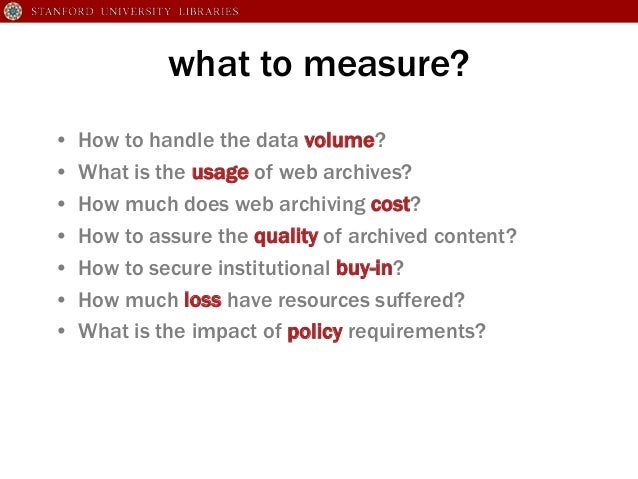
Ultimately, nothing much came of any of those discussions. We are mostly left talking about number of URL "captures" and bytes stored (3.17 billion and 64 TiB, by the way). Yet these don't really convey all that much, at least not without additional context.

Measure All the (Web Archiving) Things!
- Nicholas Taylor (Stanford University Libraries)
Another approach is to talk about websites (or seeds/hosts) captured. That still leaves you with a complicated dataset. How many crawls? How many URL per site? Etc.

Nicholas Taylor (of Stanford University Libraries) recently shared some slides on this subject, that I found quite interesting and revived this topic in my mind.

It can be a very frustrating exercise to communicate the qualities of your web archive. If Internet Archive has 434 billion web pages and I only have 3.17 billion does that make IA's collection 137 times better?

I imagine anyone who's reading this knows that that isn't how things work. If you are after world wide coverage, IA's collection is infinitely better than mine. Conversely, for Icelandic material, the Icelandic web archive is vastly deeper than IA's.

We are, therefore, left writing lengthy reports. Detailing number of seeds/sites, URLs crawled, frequency of crawling etc. Not only does this make it hard to explain to others how good (or not good as the case may be) our web archive is. It makes it very difficult to judge it against other archives.

To put it bluntly, it leaves us guessing at just how "good" our archive is.

To be fair, we are not guessing blindly. Experience (either first hand or learned from others) provides useful yardsticks and rules of thumb. If we have resources for some data mining and quality assurance, those guesses get much better.

But it sure would be nice to have some handy metrics. I fear, however, that this isn't to be.

August 24, 2015

Writing WARCs

We started doing deduplication four years before we started using WARC. As the ARC format had no revisit concept, the only record of the deduplicated items from that era lies in the crawl logs.

When we put our collection online back in 2009 we built our own indexer that consumed these crawl logs so we could include these items. It worked very well at the time.

As our collection grew, we eventually hit scaling issues with the custom indexer. Ultimately, it was abandoned when we upgraded to Wayback 1.8 two years ago. We moved to use a CDX index instead. The only casualty was the early deduplication/revisit records from our ARC days which were no longer included.

So, for the last two years, I've had a task on my todo list. Create a program that consumes all of those crawl logs and spits out WARC files containing the revisit records that are missing from the ARC files.

For a while I toyed with the idea of incorporating this in a wider ARC to WARC migration effort. But it's become clear that such a migration just isn't worthwhile. At least not yet.

Recently I finally made some time to address this. I figured it shouldn't take much time to implement. Basically, the program needs to do two things:

  1. Ingest and parse a crawl.log file from Heritrix, making it possible to iterate over its lines and access specific fields. As the DeDuplicator already does this, it was a minor task to adapt the code.
  2. For each line that represented a deduplicated URI, write a revisit record in a WARC file.

Boom, done. Can knock that out in an hour, easy.

Or, I should be able to.

It turns out that writing WARCs is painfully tedious. The libraries require you to understand the structure of a WARC file very well and do nothing to guide you. There is also no useful documentation on this subject. You best bet is to find code examples, but even those can be hard to find and may not directly address your needs.

I tried both the webarchive-commons library and JWAT. Both were tedious, but JWAT was less so. Both require you to understand exactly what header fields need to be written for each record type. To know that you need to write a warcinfo field first and so on. At least JWAT made it fairly simple to configure the header fields.

Consulting both existing WARC files and the WARC spec, I was able to put all the pieces together in about half a day using JWAT.

And that's when I realized that JWAT does not track the number of bytes written out. That means I can't split the writing up to make "even sized" WARCs like Heritrix does (usually 1 GiB/file).

Darn, I need to rewrite this, after all, using webarchive-commons.

**Sigh**

It seems to me that such an important format should have better library support. A better library would save a lot of time and effort.

By saving effort, we may also wind up saving the format itself. The danger that someone will create a widely used program that writes invalid WARCs is very real. If such invalid WARCs proliferate that can greatly undermine the usefulness of the format.

It is important to make it easy to do the right thing. Right now, even someone, like myself, who is very familiar with WARC needs to double and triple check every step of a very simple WARC writing program. Never mind if you need to do something a little advanced.

Someone with less knowledge and, perhaps, less motivation to "get it right" could all too easily write something "good enough".


It is important to demystify the WARC format. Good library support would be an ideal start.

August 17, 2015

The WARC Format 1.1

The WARC Format 1.0 is an ISO standard describing the container format that web archives use to store their data. WARCs contain not only the actual file resources (HTML, images, JavaScript etc.) but also request and response headers, metadata about the resources and the overall collection, deduplication records and conversion records.

It's a pretty flexible format. It has served us quite well, but it is not perfect.

While it is an ISO standard, most of it was written by IIPC members. Indeed, it is heavily influenced the ARC format developed by The Internet Archive. So, now that the WARC format is being revisited it is only natural that the IIPC community, again, writes the first draft.

At the IIPC GA this year, in Stanford, there was a workshop where the pain points of the current specification were brought to light. There was a lot of energy in the room and people were excited. But, as everyone got back home a lot of that energy went away.

It is a lot easier to talk about change, than making it happen. Making things more difficult, few of us know much about the standards process. It all felt very inscrutable.

To help with the procedural aspect we came up with an approach that involves using the tools we are familiar with (software development). Consequently, we (and by "we" I mean Andy Jackson of the British Library) set up a GitHub project around the WARC specification.

Any problems with the existing specification could be raised there as "issues" (you'll find all the ones discussed in Stanford on there!). The existing spec could be included as markdown formatted text and any proposed changes could be submitted as "pull requests" acting on the text of the existing spec.

Currently there are two pull requests, each representing a proposed set of changes to address one specific shortcoming of the existing spec.

One of the pull requests comes from yours truly. It address the concerns of "uri agnostic revisit records". This was previously dealt with via an advisory on the subject adopted by the IIPC. This allows us to promote what has been a defacto standard into the actual standard.

The other pull request centers on improving the resolution of timestamps in WARC headers.

Neither pull request has been merged, meaning that both are up for comment and may change or be rejected altogether. There are also many issues that still need to be addressed.

I would like to encourage all interested parties (IIPC members and non-members alike) to take advantage of the GitHub venue if the WARC format is important to you. You can do this by opening issues if you have a problem with the spec that hasn't been brought up. You can do this by commenting on existing issues and pull requests, suggesting solutions or pointing out pitfalls.

And you can do this be suggesting actual edits to the standard via pull requests (let us know if you need help with the technical bits).

Ultimately, the draft thus generated will be passed on to the relevant ISO group for review and approval. This will happen (as I understand it) next year.

So grab the opportunity while it presents itself and have your say on The WARC Format 1.1.